
Reading Pet Food Labels Without the Guesswork

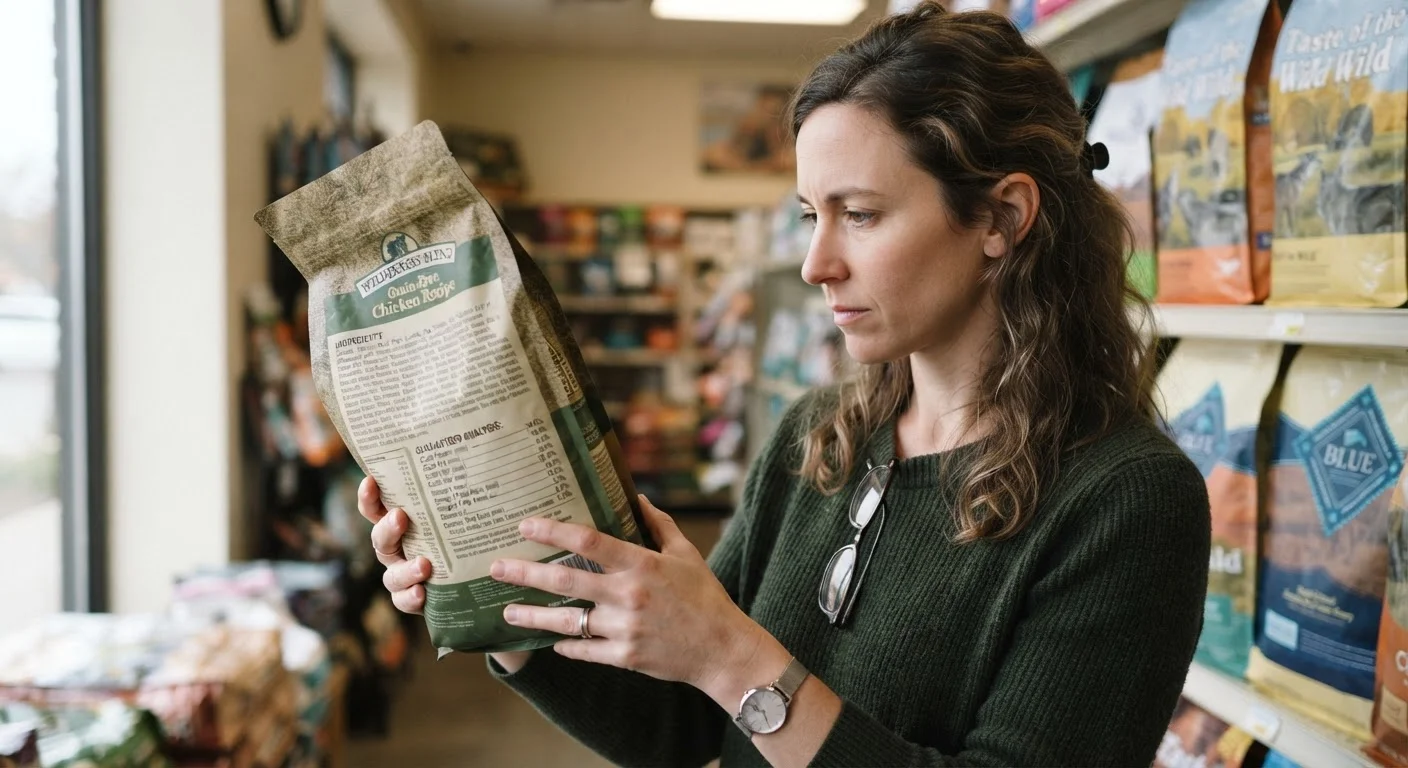
Photo: FaqsBay.com | Trending Blogs, Top Genres editorial
What's Actually on a Pet Food Label
Pet food packaging is regulated at the federal and state level, which means every label must include specific sections by law. Understanding what each section is required to say — and what it isn't — helps you filter out marketing language and focus on the information that matters.
| Required label sections | Product name, net weight, manufacturer info, ingredient list, guaranteed analysis, adequacy statement, feeding directions (AAFCO Model Pet Food Regulations) |
| Ingredient listing order | By pre-cooking (as-added) weight, heaviest first (AAFCO Model Pet Food Regulations) |
| Guaranteed analysis: protein & fat | Listed as minimums — actual content may be higher |
| Guaranteed analysis: fiber & moisture | Listed as maximums — actual content may be lower |
| AAFCO adequacy statement types | Formulated to meet nutrient profiles, or substantiated by feeding trials (AAFCO) |
| Life stages on labels | Growth, maintenance, all life stages, or supplemental/complementary (AAFCO Model Pet Food Regulations) |
Every commercially sold pet food in the US must display: the product name, net weight, manufacturer information, ingredient list, guaranteed analysis, nutritional adequacy statement, and feeding guidelines. These aren't optional — they're mandated by the AAFCO model regulations, which most states adopt into law.
What labels are not required to show: the actual nutrient profile in the form you'd need to make precise comparisons, how ingredients were processed, or sourcing origins. For a deeper look at how ingredient lists can be structured to mislead, see our guide to reading ingredient lists critically.
Breaking Down the Guaranteed Analysis
The guaranteed analysis is the nutrient panel — it lists minimum and maximum percentages for crude protein, crude fat, crude fiber, and moisture. Here's how to read it without being misled:
- "Crude" does not mean quality. Crude protein simply measures total nitrogen content — it doesn't distinguish between highly digestible animal protein and lower-digestibility plant sources.
- Minimums vs. maximums matter. Protein and fat show minimums (the food contains at least this much). Fiber and moisture show maximums. Actual values in the bag may differ.
- Moisture skews everything. Wet and dry foods can't be compared on an as-fed basis. To compare them accurately, you need to convert both to a dry matter basis — divide the nutrient percentage by (100 minus the moisture percentage), then multiply by 100.
Guaranteed Analysis
A required label panel showing minimum or maximum percentages of crude protein, fat, fiber, and moisture. It sets floors and ceilings, not exact nutrient values.
Dry Matter Basis
A method of comparing nutrients across foods by removing the effect of water content. It allows meaningful comparison between wet and dry pet foods.
AAFCO Nutritional Adequacy Statement
A mandatory label claim indicating whether a food meets AAFCO nutrient profiles through formulation or feeding trials, and for which life stage it is appropriate.
Ingredient Splitting
The practice of listing multiple forms of the same ingredient separately so each appears lower on the ingredient list, potentially masking how much of that ingredient is in the food.
Crude Protein
A measure of total nitrogen content in a pet food, used to estimate protein levels. It does not reflect protein digestibility or quality of the amino acid profile.
Meat Meal
A rendered product from animal tissues with most moisture removed. Because it is concentrated, it can deliver more protein per pound than fresh meat listed higher on the ingredient list.
The guaranteed analysis tells you the floor — not the ceiling — of what's in the food. Pair it with the ingredient list to get a more complete picture. For a broader overview of what protein sources actually deliver nutritionally, see our protein sources field guide.
The AAFCO Nutritional Adequacy Statement
This single sentence near the bottom of the label is one of the most important — and most misunderstood — parts of pet food packaging. It tells you whether the food is formulated to meet AAFCO nutrient profiles or has been proven adequate through feeding trials.
There are two types:
- Formulated to meet AAFCO nutrient profiles — The recipe was mathematically designed to hit AAFCO's minimum nutrient thresholds. No live animals were fed the food to confirm it works in practice.
- Animal feeding tests using AAFCO procedures — The food was actually fed to animals for a defined period and met established standards. This is generally considered the stronger claim.
The statement also specifies the life stage the food is intended for: "growth" (puppies/kittens), "maintenance" (adults), "all life stages," or "complementary/supplemental" (meaning it's not complete and balanced on its own). A food labeled "for all life stages" must meet the more demanding standards for growth, which means it may have higher levels of certain nutrients than an adult dog or cat needs. For a full breakdown of what these standards guarantee — and where their limits are — see our AAFCO standards explainer.
"All Life Stages" Doesn't Mean One-Size-Fits-All
Ingredient List Rules Worth Knowing
Ingredients are listed by pre-cooking weight, heaviest first. This sounds straightforward, but a few practices can distort what you're actually seeing:
- Ingredient splitting — A manufacturer can list "ground corn," "corn gluten meal," and "corn bran" separately, keeping each below the top-ranked ingredients even though corn is the dominant component by total weight.
- Fresh vs. meal — "Chicken" (fresh) contains roughly 70–80% water. After cooking, its contribution shrinks considerably. "Chicken meal" has already had moisture removed, so it delivers more concentrated protein per pound of ingredient.
- Named vs. unnamed sources — "Poultry fat" and "animal digest" are less specific than "chicken fat" or "salmon." Specificity generally correlates with more consistent sourcing.
Ingredient quality and order matter, but they don't tell the whole story without the guaranteed analysis. Use both together. For more context on how grain-free formulations shift ingredient composition — and what the research says — see our grain-free pet food explainer. You can also explore our Pet Nutrition & Diet hub for related guidance.
This article provides general educational information about pet food labeling and is not a substitute for personalized veterinary nutritional advice. Consult a licensed veterinarian or board-certified veterinary nutritionist for guidance specific to your pet's health needs.
The content provided on our blog site traverses numerous categories, offering readers valuable and practical information. Readers can use the editorial team’s research and data to gain more insights into their topics of interest. However, they are requested not to treat the articles as conclusive. The website team cannot be held responsible for differences in data or inaccuracies found across other platforms. Please also note that the site might also miss out on various schemes and offers available that the readers may find more beneficial than the ones we cover.