
Pet Food Nutrition From Puppyhood to Senior Years

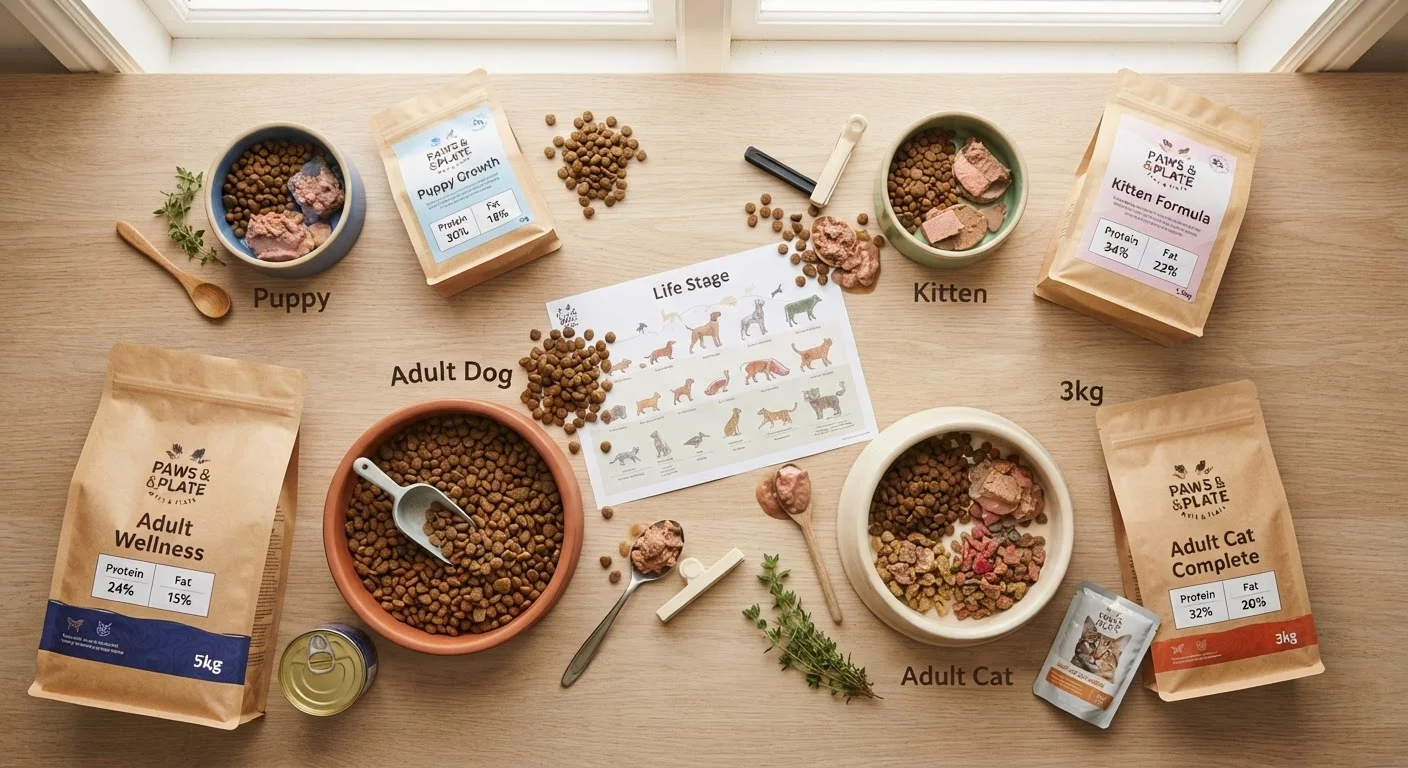
Photo: FaqsBay.com | Trending Blogs, Top Genres editorial
Key Takeaways
- Puppies and kittens require significantly more protein, fat, and specific minerals than adults.
- AAFCO life-stage statements on labels are the clearest guide to whether a food is nutritionally appropriate.
- Senior pets often need fewer calories but may need more protein to preserve muscle mass.
- Large-breed puppies have distinct calcium-to-phosphorus needs that differ from small breeds.
- Transitions between life stages should be gradual and ideally guided by your veterinarian.
Why Life-Stage Nutrition Matters
A Labrador puppy and a 12-year-old cat share very little in terms of nutritional requirements, yet both are often fed products with vague "for all life stages" claims. The reality is that what a growing animal needs to build bone, muscle, and organ tissue is fundamentally different from what a senior pet needs to maintain a healthy weight and support joint function.
Pet food formulas are not interchangeable across age groups. Feeding a kitten formula to a senior cat, for instance, may deliver excess phosphorus that stresses already-aging kidneys. Feeding an adult formula to a fast-growing large-breed puppy can leave critical mineral ratios unbalanced during the most vulnerable developmental window. Understanding why these differences exist — and how to spot them on a label — is the foundation of responsible pet ownership.
For a broader look at how species-level differences compound these concerns, see Feeding a Dog vs. Feeding a Cat: Why the Differences Matter.
Puppies and Kittens: Fueling Rapid Growth
Young animals are in a state of rapid anabolism — building tissue at a rate they will never sustain again. This demands higher concentrations of protein, fat, calcium, phosphorus, and certain vitamins relative to body weight than adult maintenance formulas provide.
When evaluating puppy food for a large breed, look specifically for a label claim referencing large-breed growth, not just 'all life stages' — the calcium levels often differ meaningfully.
Don't reduce protein in a healthy senior pet's diet without a specific clinical reason, such as confirmed kidney disease. Protein is critical for preserving lean muscle mass as animals age.
Use the AAFCO adequacy statement — not the front-of-bag marketing claims — as your primary filter when evaluating any new pet food formula.
Protein and fat: Puppies generally require a minimum of 22% crude protein and 8% crude fat (on a dry matter basis), compared to 18% and 5% for adult dogs, per AAFCO (Association of American Feed Control Officials) guidelines. Kittens, as obligate carnivores, have even higher protein requirements and additionally need dietary taurine and arachidonic acid — nutrients they cannot synthesize adequately on their own.
Calcium and phosphorus for large-breed puppies: This is one of the most consequential distinctions in pet nutrition. Large and giant breed puppies are prone to developmental orthopedic disease if calcium levels are too high. Formulas labeled specifically for large-breed puppies maintain tighter calcium-to-phosphorus ratios. Standard puppy food — even high-quality formulas — may deliver too much calcium for breeds like Great Danes or Rottweilers. The nutritional differences between small, medium, and large dog breeds go well beyond portion size.
Feeding frequency: Young animals have small stomachs and high energy demands. Three to four small meals daily is generally appropriate for puppies under six months; kittens benefit from similar frequency until about four to six months of age.
Adult Pets: Maintaining Without Overfeeding
Once a pet reaches physical maturity — roughly 12 months for most dogs and cats, though up to 24 months for large and giant breeds — the growth imperative disappears. Continuing to feed growth-stage energy and nutrient density into adulthood is one of the most common paths to obesity.
Adult maintenance formulas are calibrated to support healthy body weight and organ function without the surplus nutrients needed for rapid tissue development. Protein remains essential for muscle maintenance, enzyme production, and immune function, but the threshold is lower than during growth.
Use Body Condition Score, Not Just the Scale
Body condition score (BCS) — a hands-on assessment of fat cover over the ribs and spine — is more useful than scale weight alone for judging whether an adult pet is receiving appropriate calories. Your veterinarian can teach you how to assess BCS at home between annual checkups.
For guidance on making sound nutritional choices without overspending, Feeding Your Pet Well on a Budget offers evidence-grounded strategies that apply across life stages.
Senior Pets: Adjusting for an Aging Body
The definition of "senior" varies by species and size. Cats and small dogs are generally considered senior around age 7–8; large and giant breeds may enter their senior phase closer to age 5–6. Physiological aging involves reduced metabolic rate, decreased kidney filtration efficiency, reduced lean muscle mass, and often diminished digestive enzyme activity.
These changes create what can seem like contradictory nutritional demands. Many senior pets need fewer calories to avoid weight gain as activity decreases, but they may need more protein — not less — to counteract age-related muscle wasting (sarcopenia). Research in veterinary geriatrics increasingly supports the idea that healthy senior dogs and cats without kidney disease benefit from higher-quality, moderately elevated protein rather than restricted protein.
Kidney disease is prevalent in older cats in particular, and for those animals, phosphorus restriction does become important — but this is a clinical decision, not a blanket rule for all seniors. Work with a veterinarian before placing a senior pet on a therapeutic renal diet.
Joint support (via omega-3 fatty acids and sometimes glucosamine/chondroitin), dental health, and hydration also become increasingly relevant in senior nutrition. Senior Pet Care: What Changes After Age Seven covers the full scope of age-related adjustments beyond diet.
Reading Life-Stage Labels the Right Way
In the United States, AAFCO sets the nutritional profiles that define whether a pet food is adequate for a given life stage. Look for the AAFCO nutritional adequacy statement — a short paragraph typically found near the guaranteed analysis panel.
This statement will say one of the following:
- "Formulated to meet the nutritional levels established by AAFCO... for ." This means the formula was calculated to meet minimum nutrient profiles, but was not necessarily tested on live animals.
- "Animal feeding tests using AAFCO procedures substantiate..." This indicates the formula was validated through a feeding trial — generally considered a stronger claim.
- "Intended for intermittent or supplemental feeding only." This means the food is not nutritionally complete and should not serve as a sole diet.
"All life stages" formulas meet the most demanding AAFCO profile (growth and reproduction), which means they are technically adequate for puppies and kittens — but they may deliver more fat and calories than adult or senior pets require. They are not automatically the safest or best choice for every animal in the household.
For a deeper look at how format affects nutritional content, Dry Kibble vs. Wet Food: Nutritional Trade-Offs for Dogs and Cats walks through moisture, protein density, and palatability across formats.
When to Transition Between Life Stages
Timing a diet transition incorrectly can disrupt digestion and, in the case of growth-phase feeding extended too long, contribute to developmental problems or obesity. Here are practical guidelines:
- Puppy to Adult
- Transition small and medium breeds around 12 months. Large breeds (over 50 lbs projected adult weight) should continue on large-breed puppy formula until 12–18 months. Giant breeds may warrant extending to 18–24 months — confirm with your vet.
- Adult to Senior
- There is no single universal age trigger. Monitor body condition, energy level, muscle tone, and bloodwork results rather than birthday alone. Many veterinarians recommend senior-specific formulas when a pet's BCS or bloodwork suggests a shift is warranted.
- How to transition
- A gradual 7–10 day changeover — mixing increasing proportions of the new food with the old — reduces gastrointestinal upset regardless of life stage.
For a structured approach to establishing good nutritional habits from day one, the Starting a New Pet on a Healthy Diet checklist covers food selection, portion setting, and transition protocols in practical detail.
This article provides general nutritional education for pet owners and is not a substitute for personalized veterinary advice. Always consult your veterinarian before making significant changes to your pet's diet, especially for animals with existing health conditions.
The content provided on our blog site traverses numerous categories, offering readers valuable and practical information. Readers can use the editorial team’s research and data to gain more insights into their topics of interest. However, they are requested not to treat the articles as conclusive. The website team cannot be held responsible for differences in data or inaccuracies found across other platforms. Please also note that the site might also miss out on various schemes and offers available that the readers may find more beneficial than the ones we cover.