
Hardwood Flooring Vs. Engineered Wood: Understanding the Structural and Practical Differences

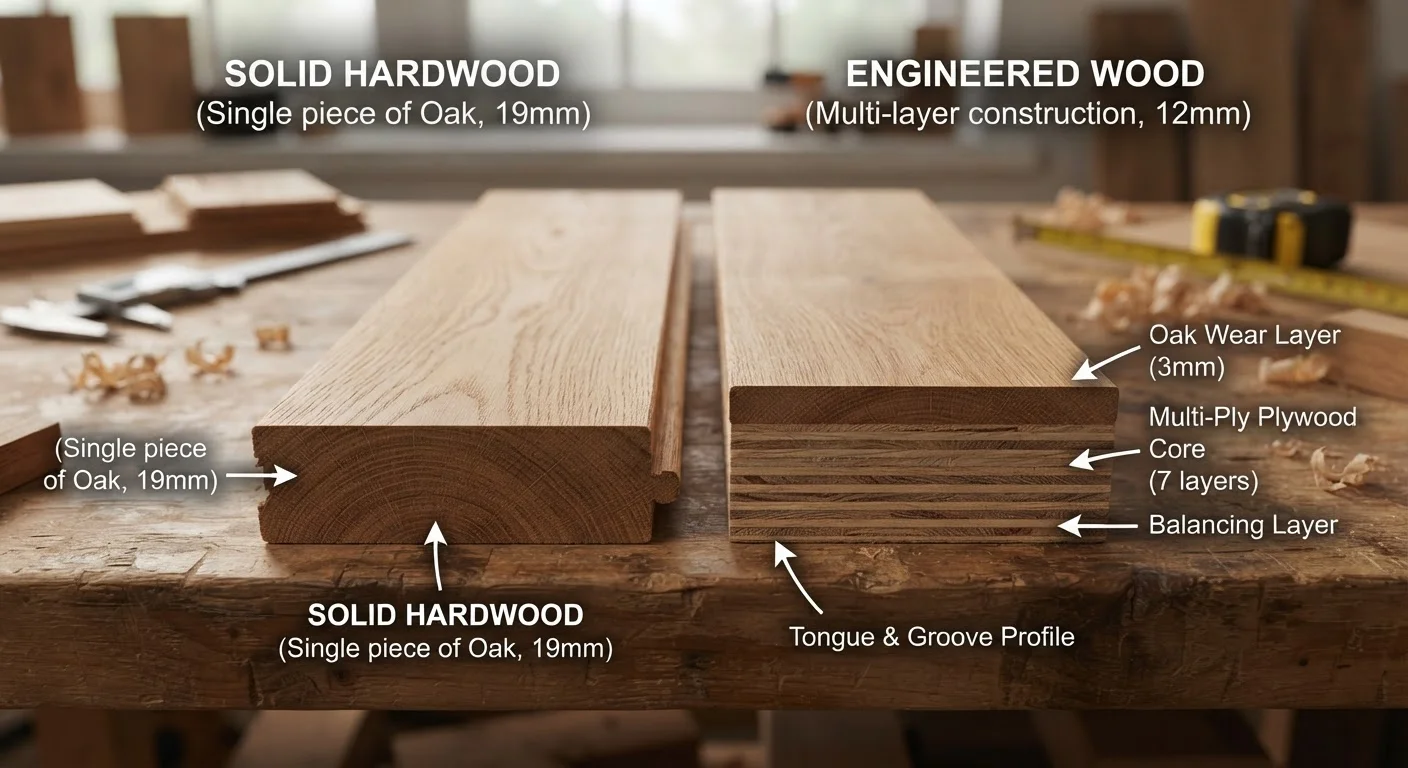
Photo: FaqsBay.com | Trending Blogs, Top Genres editorial
Key Takeaways
- Solid hardwood is milled from one piece of wood and can be sanded and refinished multiple times over decades.
- Engineered wood uses a real wood veneer over a plywood or HDF core, giving it greater dimensional stability.
- Engineered wood handles humidity and subfloor variations better, making it suitable for basements and slab installations.
- Solid hardwood is generally limited to above-grade, well-ventilated spaces with controlled moisture levels.
- Both products offer genuine wood aesthetics, but their long-term care and installation requirements differ significantly.
How Each Floor Is Built
The most important difference between these two flooring types is what's inside the plank — not what you see on top.
Solid hardwood is exactly what it sounds like: a plank milled from a single piece of lumber, typically ¾ inch thick. Species like oak, maple, and hickory are common. Because the entire plank is wood, it responds as a single unit to temperature and humidity — expanding when moisture rises and contracting when it falls.
Engineered wood is a layered product. A thin real-wood veneer (the wear layer) sits on top of a core made from cross-directional plywood layers or high-density fiberboard (HDF). Those alternating layers are bonded at opposing grain directions, which is what gives engineered wood its dimensional stability. The top surface looks and feels like solid wood — because it is real wood — but the core behaves very differently under stress.
| Criterion | Solid Hardwood | Engineered Wood |
|---|---|---|
| Core construction | Single piece of solid lumber | Real wood veneer over plywood or HDF core |
| Typical thickness | ¾ inch standard | ⅜ inch to ¾ inch, varies by product |
| Below-grade installation | Not recommended | Possible with moisture barrier |
| Over concrete subfloor | Generally not suitable | Compatible with proper prep |
| Installation methods | Nail or staple down only | Nail, glue, or float (click-lock) |
| Moisture stability | Expands and contracts noticeably | More dimensionally stable |
| Refinishing potential | Multiple times over lifetime | Limited; depends on veneer thickness |
| Surface appearance | Genuine solid wood grain throughout | Real wood veneer on top surface |
Installation, Subfloor Compatibility, and Moisture
Where you're installing matters as much as which product you choose.
Solid hardwood must be nailed or stapled down to a wood subfloor and is not recommended below grade (basements) or directly over concrete. It requires a dry, well-ventilated space and a moisture content-tested subfloor. Most installers allow solid hardwood to acclimate in the room for several days before installation.
Engineered wood is more versatile. Depending on the product, it can be glued, stapled, or floated using a click-lock system — and it's compatible with concrete subfloors when proper moisture barriers are used. This makes it a practical choice for slab-on-grade homes, renovated basements, and regions with high humidity. It still requires acclimation, but its cross-ply core means it tolerates moderate moisture variation without significant movement.
Moisture Testing Before Installation
If you're planning a mixed-material floor layout, understanding how each product behaves at transitions is important. Our guide to mixing wood tones covers how to handle visual continuity when moving between rooms or materials.
Refinishing, Longevity, and Everyday Wear
Both floors can last decades with proper care, but their long-term maintenance paths differ.
Solid hardwood can typically be sanded and refinished three to five times over its lifespan, depending on plank thickness. This makes it a genuinely renewable surface — scratches, dents, or worn finishes can be addressed without replacing the floor. That refinishing potential is a meaningful advantage in high-traffic areas where surface wear accumulates over time.
Engineered wood's refinishing potential depends on the thickness of its wear layer, which varies by product. Thicker veneer layers (2mm or more) may support one or two light sandings; thinner veneers cannot be sanded at all. Scratches in the wear layer that go through to the core cannot be refinished away. However, engineered floors with durable factory finishes often resist everyday surface wear quite well without needing refinishing for many years.
¾"
Standard solid hardwood plank thickness
This thickness allows for multiple refinishing cycles — typically three to five sandings over the floor's lifetime.
2mm+
Veneer thickness enabling refinishing
Engineered wood wear layers below 2mm are generally considered too thin to sand without risking damage to the core layer.
3–5×
Refinishing cycles for solid hardwood
Industry guidance generally estimates solid ¾-inch hardwood can be sanded and refinished three to five times across its usable life.
For context on other flooring decisions in the same space, see our comparison of natural and synthetic rugs — especially relevant if you're layering rugs over a new wood floor.
This article provides general home improvement information for educational purposes. Costs, performance, and installation requirements vary by product, region, and specific site conditions. Always consult a qualified flooring professional for guidance on your specific project.
The content provided on our blog site traverses numerous categories, offering readers valuable and practical information. Readers can use the editorial team’s research and data to gain more insights into their topics of interest. However, they are requested not to treat the articles as conclusive. The website team cannot be held responsible for differences in data or inaccuracies found across other platforms. Please also note that the site might also miss out on various schemes and offers available that the readers may find more beneficial than the ones we cover.