
Reading a Window Sticker: A Field Guide to Monroney Label Terms

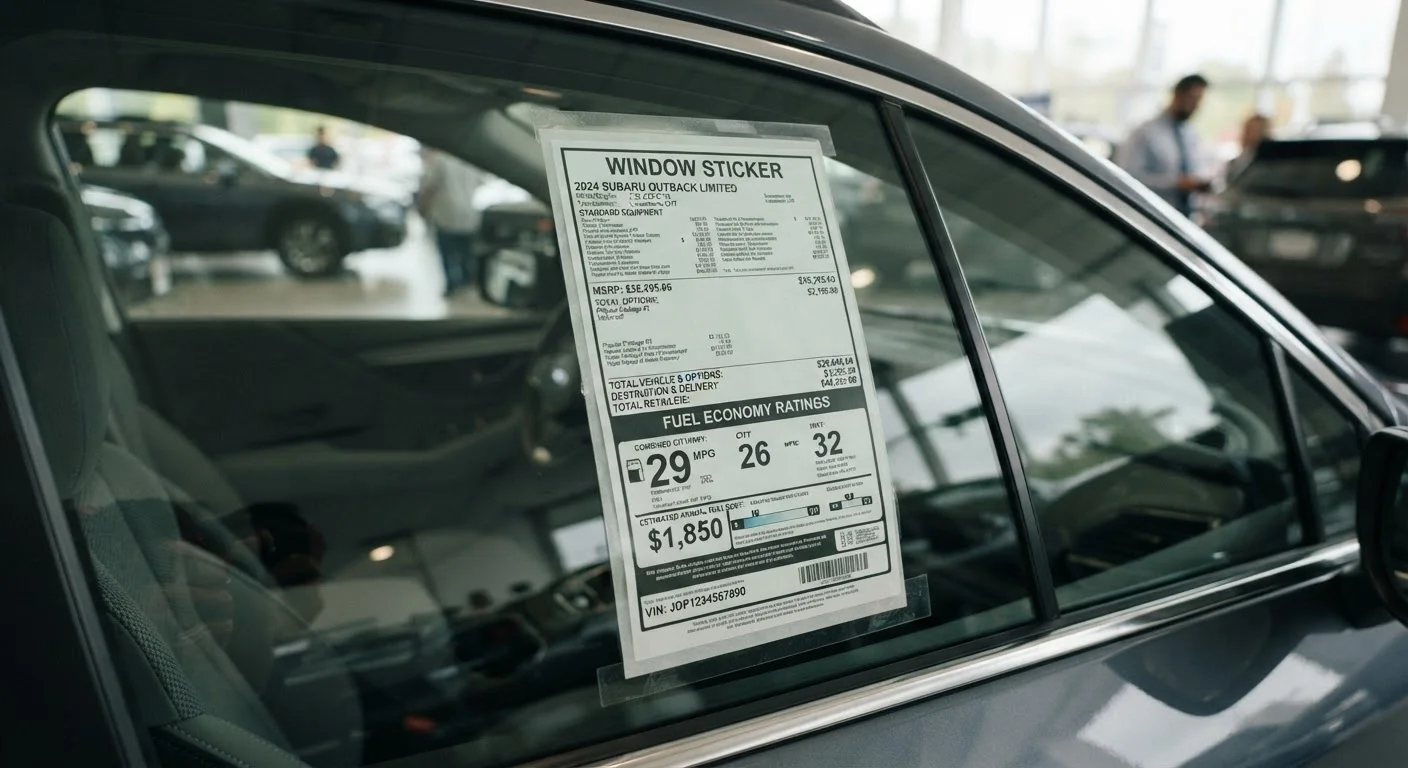
Photo: FaqsBay.com | Trending Blogs, Top Genres editorial
What Is the Monroney Label?
Walk onto any new-car lot and you'll see a paper label adhered to the window of every vehicle. That label has an official name: the Monroney sticker, named after Senator Mike Monroney, whose 1958 Automobile Information Disclosure Act made it a federal requirement. Dealers are legally prohibited from removing it before a sale. Its purpose is straightforward - to give buyers a standardized snapshot of the vehicle's pricing, features, fuel economy, and safety ratings before any negotiation begins.
Understanding each section of the label lets you separate a vehicle's true factory value from costs that are negotiable or even avoidable. That clarity is especially useful when you read it alongside the fine print dealers don't always surface during a sale.
| Law Requiring the Label | Automobile Information Disclosure Act (1958) |
| Who Sets the Destination Charge | The vehicle manufacturer - identical for all buyers of that model |
| Is MSRP Negotiable? | Yes - it is a suggested price, not a fixed one |
| Are Dealer Add-Ons Negotiable? | Generally yes - addendum sticker items carry dealer-set prices |
| Fuel Economy Source | U.S. Environmental Protection Agency (EPA) standardized testing |
| Safety Rating Bodies | NHTSA (federal) and IIHS (independent) |
Decoding Every Line: From Base Price to Final Total
The sticker is divided into distinct sections. Here's what each one actually means:
Base MSRP
The Manufacturer's Suggested Retail Price (MSRP) for the vehicle's standard trim level. It reflects factory costs plus a manufacturer profit margin - it is a suggestion, not a fixed price. Dealers can sell above or below this figure.
Options and Packages
Individually installed features - sunroofs, upgraded audio, advanced driver-assist packages - are listed separately with their own MSRP line items. Review these carefully; some options may have been added by the dealer rather than ordered from the factory, which can affect negotiability.
Destination and Delivery Charge
A fixed fee set by the manufacturer to cover transporting the vehicle from the assembly plant to the dealership. This charge is non-negotiable and identical for all buyers purchasing that model, regardless of how far the dealership is from the plant.
Total MSRP
The sum of the base price, all factory options, and the destination charge. This is the number most often quoted in advertising. It does not include taxes, registration fees, or any dealer additions.
Dealer-Added Items
Many dealers attach a second label - sometimes called an addendum sticker - listing items installed after the vehicle left the factory (paint sealant, nitrogen-filled tires, window tinting, cargo nets). These are typically priced with significant margins and are almost always negotiable. Do not assume they are part of the manufacturer's package.
MSRP
Manufacturer's Suggested Retail Price - the price a vehicle's maker recommends dealers charge. It is a starting point for negotiation, not a fixed sale price.
Monroney Sticker
The federally mandated window label on every new vehicle, disclosing the base price, options, destination charge, and fuel economy. Dealers cannot legally remove it before the sale.
Destination Charge
A fixed manufacturer fee covering transport from the assembly plant to the dealership. It applies equally to all buyers of that model and is not negotiable.
Addendum Sticker
A secondary label added by the dealer listing items installed after the vehicle left the factory. These are separate from the Monroney label and their prices are often negotiable.
Dealer Markup
An amount added above the MSRP by the dealership, often during periods of high demand or limited inventory. It appears on the addendum sticker rather than the official Monroney label.
EPA Fuel Economy Rating
Standardized city, highway, and combined miles-per-gallon estimates produced by the U.S. Environmental Protection Agency. Real-world results vary based on driving style and conditions.
Fuel Economy Ratings
EPA-estimated city, highway, and combined miles per gallon (or MPGe for plug-in vehicles) are printed on the label. These are standardized test figures - actual real-world fuel economy varies based on driving habits, load, and conditions.
Safety Ratings
Some labels include NHTSA (National Highway Traffic Safety Administration) or IIHS (Insurance Institute for Highway Safety) ratings. A vehicle that has not yet been tested will show no rating; absence of a rating is not the same as a poor rating.
Once you understand what is factory-set and what is dealer-added, you're in a much stronger position for negotiation. The negotiating guide covers exactly how to use this knowledge at the table.
Sticker Price vs. What You'll Actually Pay
The total MSRP on the Monroney label is rarely the final out-of-pocket number. Several additional costs appear at the finance office:
- Sales tax - calculated on the sale price (and sometimes on trade-in value, depending on state law)
- Title and registration fees - set by your state DMV
- Documentation fee - a dealer administrative charge that varies widely by state and dealership
- Dealer markup (or market adjustment) - an amount added above MSRP, sometimes listed on the addendum sticker, particularly on high-demand vehicles
The gap between sticker price and total drive-off cost can be significant. For context on how new-vehicle pricing compares to used options, the new vs. used price comparison breaks down where real value differences lie.
Once you've purchased, you'll also want to budget for ongoing coverage. The car insurance hub offers clear guidance on coverage types and what factors influence your premium.
This article is for general informational purposes only and does not constitute financial or legal advice. Always verify fees, taxes, and regulatory requirements with the relevant authorities or a qualified professional before making a purchase decision.
The content provided on our blog site traverses numerous categories, offering readers valuable and practical information. Readers can use the editorial team’s research and data to gain more insights into their topics of interest. However, they are requested not to treat the articles as conclusive. The website team cannot be held responsible for differences in data or inaccuracies found across other platforms. Please also note that the site might also miss out on various schemes and offers available that the readers may find more beneficial than the ones we cover.