
Community College vs. Four-Year University: Mapping the Trade-Offs

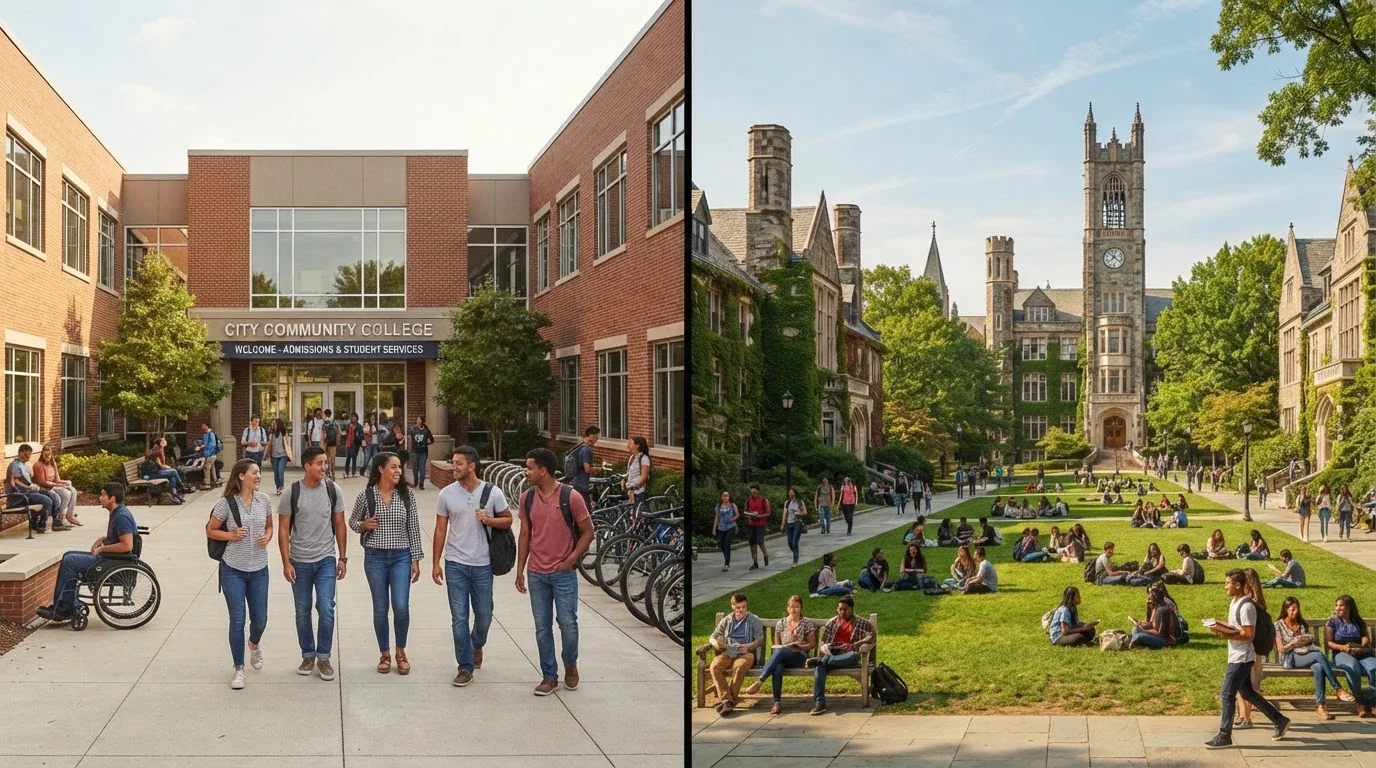
Photo: FaqsBay.com | Trending Blogs, Top Genres editorial
Key Takeaways
- Community college tuition averages a fraction of four-year university costs, significantly reducing student debt risk.
- Transfer pathways from community college to university are well-established but require careful planning to succeed.
- Four-year universities typically offer more extensive career networks, alumni connections, and on-campus resources.
- Community colleges serve adult learners, part-time students, and career-changers with greater scheduling flexibility.
- Neither path guarantees outcomes - completion rates, field of study, and individual effort matter more than institution type.
Cost: The Number That Changes Everything
The most significant concrete difference between these two paths is price. According to the College Board's Trends in College Pricing report, the average published in-state tuition and fees at a public two-year college is roughly $3,900 per year, compared to approximately $11,260 at a public four-year university and over $41,000 at private four-year institutions. Those figures don't include housing, transportation, or personal expenses - all of which compound quickly at residential universities.
For families evaluating the full financial picture of college, community college can represent a meaningful way to reduce total debt - especially if the student transfers after two years. However, cost comparisons require looking at net price, not sticker price. Many four-year universities offer substantial merit or need-based aid that narrows the gap. Learning to decode a financial aid award letter is essential before drawing conclusions from published tuition rates alone.
| Criterion | Community College | Four-Year University |
|---|---|---|
| Average Annual Tuition (public) | ~$3,900 (in-state) | ~$11,260 (in-state) |
| Admissions | Open access | Competitive or selective |
| Credential Awarded | Certificate or Associate degree | Bachelor's degree (or higher) |
| Typical Program Length | 1-2 years | 4 years |
| Schedule Flexibility | High (evening, weekend, hybrid) | Moderate (varies by institution) |
| Campus Life & Housing | Limited; mostly commuter | Extensive; residential options |
| Transfer to Four-Year | Common; articulation agreements exist | Not applicable |
| Six-Year Completion Rate | Lower (varies widely) | Higher on average |
Flexibility, Access, and Student Profiles
Community colleges are open-access institutions - meaning they admit all applicants with a high school diploma or equivalent, with no competitive admissions process. This makes them a realistic option for students who didn't pursue a rigorous high school curriculum, those returning to education after years in the workforce, or career-changers seeking new credentials quickly.
Scheduling flexibility is another structural advantage. Most community colleges offer significant evening, weekend, and online coursework, accommodating students who work full-time or manage family responsibilities. Four-year universities, particularly residential ones, are more oriented around traditional 18-22-year-old students attending full-time. Some do offer substantial online or hybrid options - see our comparison of online degrees vs. traditional campus programs for details on that dimension.
40%
Share of US undergraduates at community colleges
The American Association of Community Colleges estimates that about 40% of all undergraduate students in the US attend a community college.
~$3,900
Average annual community college tuition (in-state, public)
According to the College Board's Trends in College Pricing, average published tuition and fees at public two-year colleges remain a fraction of four-year costs.
80%+
Community college students who say they intend to transfer
National surveys consistently find most community college students initially intend to earn a bachelor's degree, though actual transfer rates are considerably lower.
Transfer Pathways: The Bridge Between Both Worlds
A well-executed community college-to-university transfer is one of the most cost-effective strategies in higher education. Many states have formalized articulation agreements - contracts between community colleges and public universities that guarantee credit transfer for students who complete an associate degree with minimum GPA requirements. California's TAG (Transfer Admission Guarantee) program and similar initiatives in Florida, Virginia, and Texas are prominent examples.
The key word is well-executed. Students who don't consult a transfer counselor early, who take courses outside the articulation agreement, or who delay the transfer application process often find that credits don't transfer cleanly. The result can be additional semesters at the four-year institution - eroding the cost savings that motivated the strategy. Planning matters as much as the pathway itself.
For students still deciding whether a credential short of a bachelor's degree might serve their goals, the comparison of online certificates vs. degree programs offers useful context on career outcomes by credential type.
Campus Experience and Long-Term Outcomes
Four-year universities tend to offer a qualitatively different student experience: residential life, Division athletics, research labs, career fairs with large employer networks, and alumni connections spanning decades. These aren't trivial - career outcomes are influenced by institutional networks, internship pipelines, and the peer communities students build during college. Whether that premium is worth the cost depends heavily on the field and the individual.
Community college completion rates are a genuine concern. National data from the National Student Clearinghouse consistently shows lower six-year completion rates at two-year institutions compared to four-year ones. Multiple factors contribute - financial stress, part-time enrollment, and life circumstances outside the classroom - but the pattern is real and worth weighing. Students who begin at community college with a clear plan and support system complete at much higher rates than those without one.
When evaluating fit beyond reputation or rankings, consider what college fit really means - an institution that matches your learning style, support needs, and goals tends to produce better outcomes than a prestigious name alone.
This article is for general informational and educational purposes only. It does not constitute financial, academic, or personalized college counseling advice. Students and families should consult qualified advisers, institutional counselors, and official government sources when making higher education decisions.
The content provided on our blog site traverses numerous categories, offering readers valuable and practical information. Readers can use the editorial team’s research and data to gain more insights into their topics of interest. However, they are requested not to treat the articles as conclusive. The website team cannot be held responsible for differences in data or inaccuracies found across other platforms. Please also note that the site might also miss out on various schemes and offers available that the readers may find more beneficial than the ones we cover.