
Currency Exchange vs. Travel Credit Cards: Handling Money Abroad

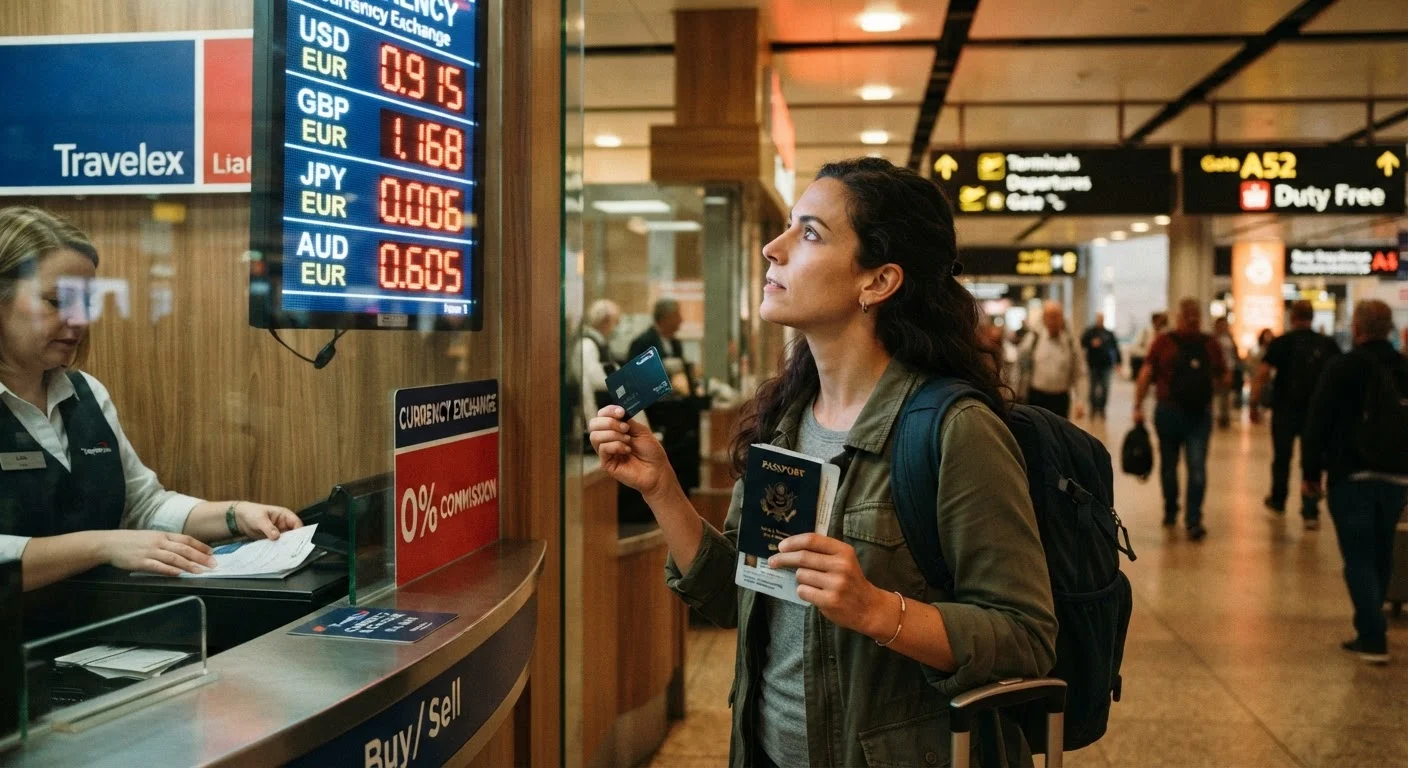
Photo: FaqsBay.com | Trending Blogs, Top Genres editorial
Key Takeaways
- Airport currency exchange counters typically offer some of the worst exchange rates available to travelers.
- Travel credit cards with no foreign transaction fees can deliver near-market exchange rates on every purchase.
- Cash remains essential in many destinations — rural areas, local markets, and some countries are largely cash-only.
- Dynamic Currency Conversion is a common trap at card terminals abroad; always choose to pay in local currency.
- A combined strategy — card for larger purchases, modest cash for small vendors — works well for most trips.
How Each Option Actually Works
When you exchange dollars for foreign currency — at a bank, a bureau de change, or an airport kiosk — you receive physical cash at whatever rate the exchanger sets that day, plus a service fee. The exchange rate offered to retail customers almost always sits below the interbank rate (the wholesale rate banks use with each other), meaning you're paying a built-in spread even before any flat fee is charged. Airport and hotel counters tend to mark up that spread the most, while banks and dedicated exchange services are generally more competitive.
Travel credit cards work differently. When you tap your card at a shop in Tokyo or a restaurant in Lisbon, your card network — Visa or Mastercard — converts the transaction using a rate very close to the interbank benchmark. Cards without a foreign transaction fee pass that rate directly to you. Cards with a foreign transaction fee (commonly 2–3% of each purchase) add that charge on top, which can quietly eat into your travel budget over a two-week trip.
Before your next trip, it's worth reviewing this pre-departure checklist — it walks through notifying your bank and understanding your card's overseas policies before you fly.
| Criterion | Currency Exchange | Travel Credit Cards |
|---|---|---|
| Exchange rate quality | Below interbank; varies by vendor | Near interbank (no-fee cards) |
| Fees | Spread + possible flat service fee | 0–3% foreign transaction fee |
| Convenience | Requires advance planning or airport stop | Instant; tap or insert abroad |
| Accepted everywhere? | Yes — cash is universal | No — rural/local vendors may be cash-only |
| Security if lost | Cash lost is unrecoverable | Card can be frozen or replaced |
| Best exchange location | Bank or dedicated bureau (not airport) | N/A — network handles conversion |
| Budget control | Spend only what you carry | Requires discipline; easy to overspend |
Costs and Traps to Watch For
The biggest hidden cost in currency exchange isn't always a labeled fee — it's the spread baked into the quoted rate. If the market rate is 1.10 euros per dollar and the counter quotes you 1.02, you've effectively paid roughly 7% on your exchange without seeing a single "fee" line. Exchanging large amounts magnifies this effect considerably.
On the card side, the most common trap is Dynamic Currency Conversion (DCC). At many overseas card terminals, the machine will offer to process your payment in US dollars rather than local currency — framed as a convenience. Decline every time. When a foreign merchant handles the conversion, their rate is almost always worse than your card network's rate. Always choose to pay in the local currency and let your card do the conversion.
A Word on Airport Currency Exchange
ATM withdrawals abroad introduce another variable. Many US debit cards charge a flat international ATM fee per withdrawal — often $3–$5 — plus a percentage. Withdrawing a larger sum less frequently keeps those fees manageable. Some banks reimburse international ATM fees entirely, so it's worth checking your account terms before you leave.
For a broader look at what international travel actually costs — and which assumptions about expense are myths — see our breakdown of common travel budget myths.
Building a Smart Money Strategy for Your Trip
For most US travelers, the answer isn't either/or — it's a deliberate combination. Use a no-foreign-transaction-fee credit card as your default payment method at hotels, restaurants, and larger retailers. For local transport, small vendors, tips, and cash-only establishments, carry a modest amount of local currency obtained either from your home bank before departure (often at competitive rates if ordered in advance) or from an ATM upon arrival rather than an airport exchange counter.
If you're heading somewhere where cash genuinely dominates — think rural Southeast Asia, parts of Central America, or local markets in Morocco — weight your strategy more heavily toward cash and plan to replenish from ATMs in larger towns rather than pre-exchanging a large sum stateside.
Wherever you're going, verify entry and payment realities before you land. Official government travel advisories and your destination's tourism authority are reliable starting points. Planning your first international trip and want a full overview? Our complete first-time international travel guide covers money, passports, safety, and more in one place.
This article is for general informational purposes only and does not constitute personalized financial advice. Exchange rates, card terms, and fees vary by provider and change over time. Verify all fees and policies with your bank or card issuer before traveling.
The content provided on our blog site traverses numerous categories, offering readers valuable and practical information. Readers can use the editorial team’s research and data to gain more insights into their topics of interest. However, they are requested not to treat the articles as conclusive. The website team cannot be held responsible for differences in data or inaccuracies found across other platforms. Please also note that the site might also miss out on various schemes and offers available that the readers may find more beneficial than the ones we cover.