
The Language of Fitness: Key Terms Every New Exerciser Should Know

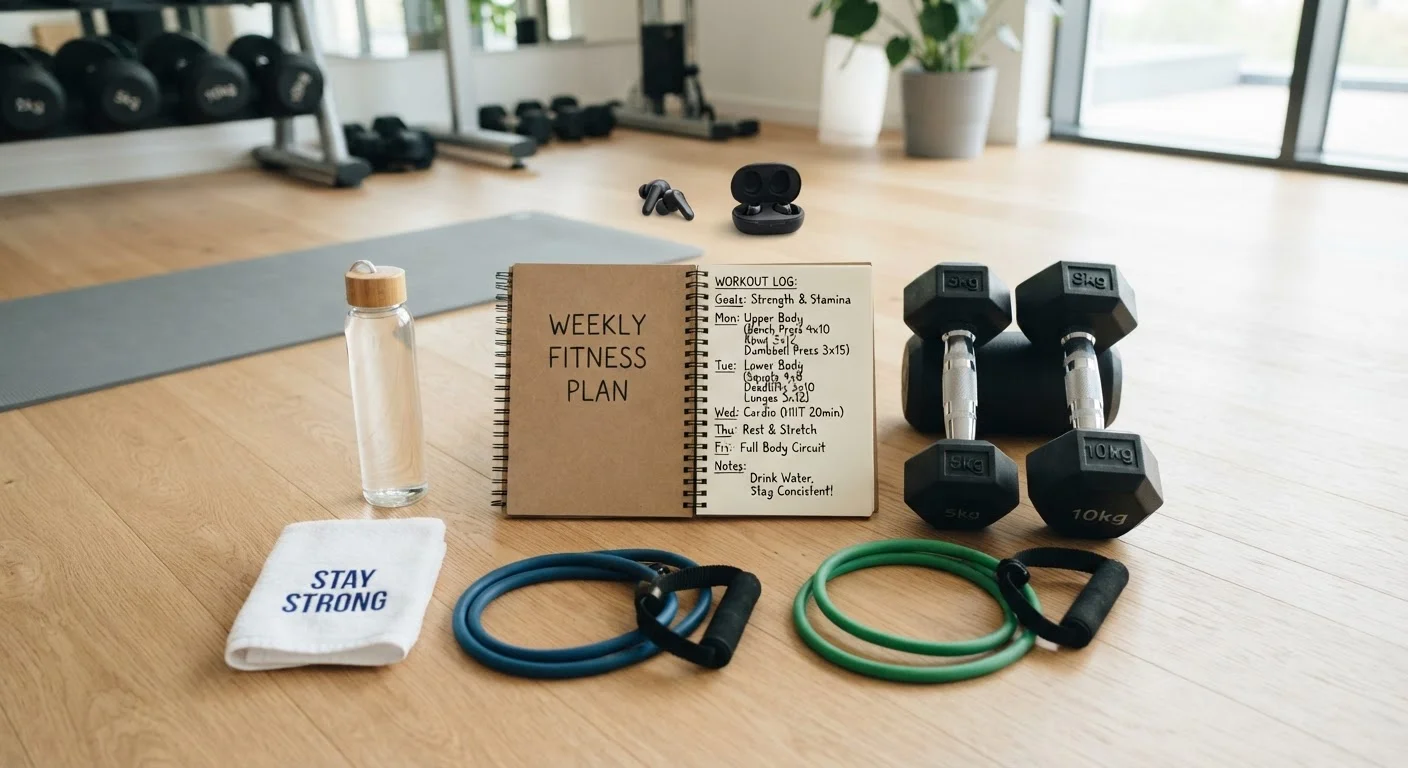
Photo: FaqsBay.com | Trending Blogs, Top Genres editorial
Why Fitness Terminology Matters
Walking into a gym or opening a workout app for the first time can feel like arriving in a foreign country. Instructions to "complete three sets of twelve reps at RPE 7" or "alternate between AMRAP blocks and active recovery" are confusing without context - and confusion is one of the most common reasons beginners abandon new routines.
This reference guide defines the terms you're most likely to encounter across gym floors, fitness apps, and workout videos. Think of it as a pocket dictionary for physical activity: no medical jargon, no assumptions about prior experience. Just clear explanations that help you follow programs confidently and make smarter decisions about your training.
Just as understanding a new field starts with its vocabulary - the way our online learning glossary helps new students navigate digital education - knowing fitness terms puts you in control of your own progress.
| Most fundamental unit of exercise | The repetition (rep) |
| Primary driver of long-term fitness gains | Progressive overload (American College of Sports Medicine guidelines) |
| Typical beginner rest period between sets | 60-90 seconds (General exercise science guidance) |
| RPE scale range | 1 (minimal effort) to 10 (maximum effort) |
| HIIT workout typical duration | 20-40 minutes (Common program design standards) |
| Minimum recommended weekly aerobic activity for adults | 150 minutes moderate-intensity or 75 minutes vigorous-intensity (U.S. Department of Health and Human Services Physical Activity Guidelines) |
Core Training Concepts
These are the building blocks that appear in virtually every structured workout program.
Rep (Repetition)
A single, complete execution of an exercise movement - one squat, one push-up, one bicep curl. Reps are the smallest unit of workout volume.
Set
A group of consecutive reps performed without stopping to rest. Most programs specify both the number of sets and the number of reps per set (e.g., 3 sets of 12 reps).
Progressive Overload
Gradually increasing the demands placed on the body over time - through more weight, more reps, less rest, or greater complexity - to continue driving adaptation and avoid plateaus.
HIIT
High-Intensity Interval Training. A format alternating short bursts of near-maximum effort with recovery periods. It can improve cardiovascular fitness efficiently but is demanding and not appropriate for all fitness levels.
Compound Movement
An exercise that engages multiple muscle groups and joints simultaneously, such as a squat, deadlift, or row. Generally considered highly efficient for building overall strength.
Isolation Exercise
An exercise that targets a single muscle group at one joint, such as a bicep curl or leg extension. Often used to address specific muscle development alongside compound training.
1RM (One-Rep Max)
The maximum amount of weight a person can lift for a single full repetition of a given exercise. Used as a benchmark to calculate training loads across a program.
Hypertrophy
The increase in muscle size that results from consistent resistance training. It occurs when muscle fibers are stressed and repair themselves slightly larger and stronger over time.
Periodization
A structured approach to planning training over weeks or months, cycling through phases of volume, intensity, and recovery to optimize long-term progress and prevent overtraining.
Active Recovery
Low-intensity movement performed on rest days or between hard sessions - such as walking or light stretching - intended to support circulation and reduce muscle soreness without adding significant training load.
RPE (Rate of Perceived Exertion)
A subjective scale (typically 1-10) used to self-assess how hard an exercise feels. It helps guide workout intensity based on how the body feels on a given day, rather than fixed external metrics alone.
Warm-Up / Cool-Down
A warm-up is low-intensity movement performed before a workout to prepare the body for exercise. A cool-down is gentle activity after training to help the body transition back to a resting state.
Understanding how these terms interact is key. A set is a group of consecutive repetitions performed without resting. So "3 sets of 10 reps" means you perform an exercise 10 times, rest briefly, and repeat that sequence two more times. Progressive overload - gradually increasing the challenge over time - is widely considered the central mechanism driving long-term strength and fitness gains.
Once you're comfortable with these basics, you may want to explore how different training styles apply them. Our guide on HIIT vs. steady-state cardio explains how high-intensity intervals and sustained-effort training each use these principles differently.
Intensity, Recovery, and Program Design
Beyond basic movements, fitness programs are shaped by how hard you work, how you recover, and how your training is structured over time.
RPE (Rate of Perceived Exertion) is a self-reported scale - typically 1 to 10 - that measures how hard an exercise feels. An RPE of 6 means moderate effort; an RPE of 9 means near-maximum. It's a useful tool because it accounts for daily variation in how your body feels, rather than relying solely on fixed numbers like weight or speed.
AMRAP stands for "As Many Reps (or Rounds) As Possible" within a set time window. It's a common format in circuit and functional fitness training. EMOM - Every Minute On the Minute - means you start a prescribed number of reps at the top of each minute, using any remaining time to rest before the next round begins.
Periodization refers to organizing training into planned phases - such as building volume, then increasing intensity, then tapering - to promote consistent progress and reduce overtraining risk. Many structured programs follow this approach, even if the term itself never appears in the plan.
Active recovery describes low-intensity movement (walking, gentle stretching, easy cycling) performed on rest days or between hard efforts. It supports circulation and can help reduce muscle soreness without adding significant training stress.
A Note on Individual Variation
If you've been away from exercise for a while, these concepts become especially relevant. Our article on returning to exercise after a long break walks through how to apply progressive overload safely when restarting.
Using This Reference Going Forward
Fitness language evolves, and different communities - powerlifting, yoga, endurance sports, functional training - each carry their own vocabulary. This glossary covers the core terms most likely to appear across general fitness contexts, but it's worth noting that some terminology is used inconsistently even among fitness professionals.
When in doubt about how a specific term applies to your situation - particularly if you have a health condition, injury, or are new to physical activity - a certified personal trainer or your healthcare provider is the most reliable resource. General education is a strong foundation, but individual guidance matters. Just as you'd consult a licensed professional for personal finance decisions, knowing when to seek expert input in fitness is a skill in itself.
This article is for general informational and educational purposes only and is not a substitute for professional medical or fitness advice. Consult a qualified healthcare provider or certified fitness professional before beginning any new exercise program.
The content provided on our blog site traverses numerous categories, offering readers valuable and practical information. Readers can use the editorial team’s research and data to gain more insights into their topics of interest. However, they are requested not to treat the articles as conclusive. The website team cannot be held responsible for differences in data or inaccuracies found across other platforms. Please also note that the site might also miss out on various schemes and offers available that the readers may find more beneficial than the ones we cover.