
Synchronous vs. Asynchronous Online Courses: Choosing the Right Format for Your Life

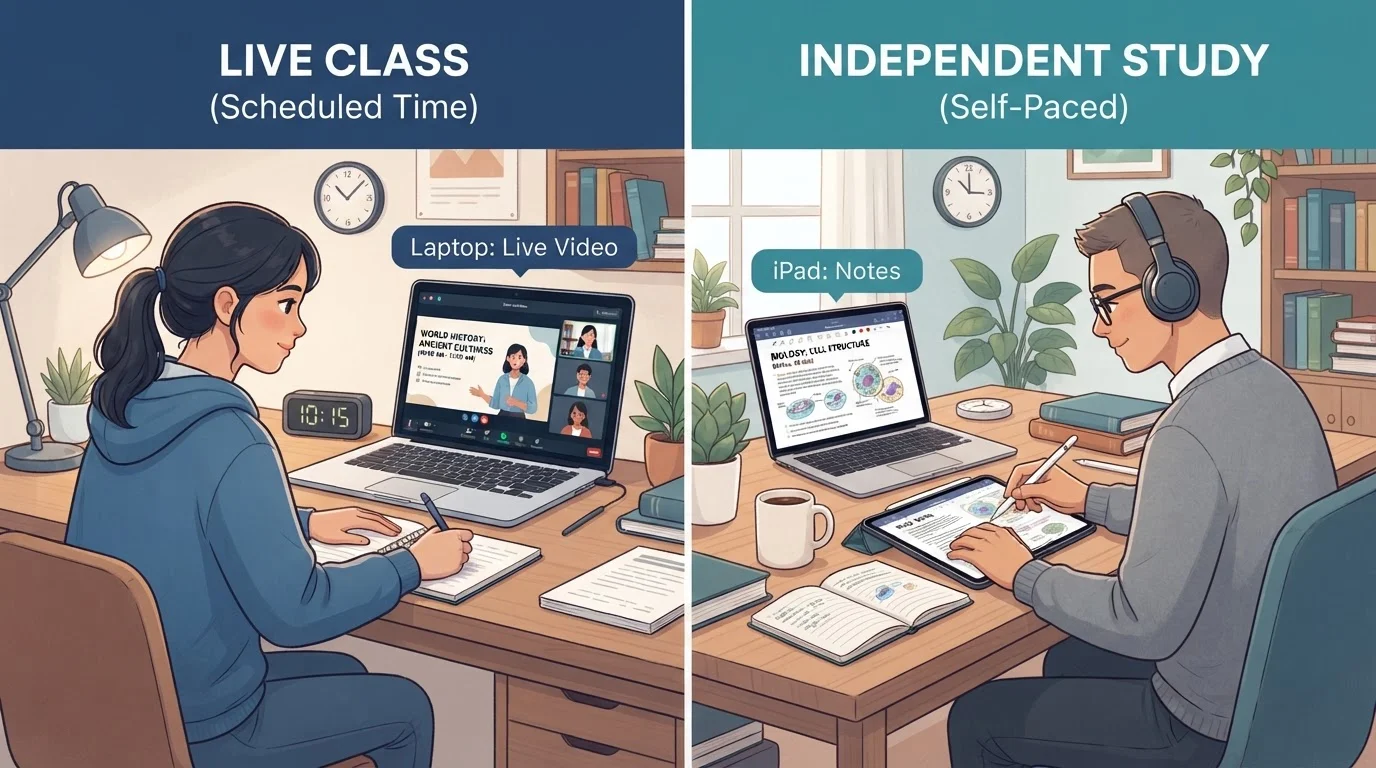
Photo: FaqsBay.com | Trending Blogs, Top Genres editorial
Key Takeaways
- Synchronous courses meet at set times via live video; asynchronous courses let you complete work on your own schedule.
- Synchronous formats tend to offer stronger peer interaction and built-in accountability from instructors.
- Asynchronous courses typically provide greater scheduling flexibility, suiting working adults and caregivers.
- Neither format is inherently superior - the right choice depends on your lifestyle, goals, and learning style.
- Many programs now blend both formats, so understanding both helps you evaluate any course you consider.
What These Terms Actually Mean
Before choosing a course, it helps to understand exactly what each format involves. If you encounter unfamiliar terms during your research, the Online Learning Glossary offers plain-language definitions worth bookmarking.
Synchronous (from the Greek for "same time") means all participants engage at the same moment. In an online context, this usually means live video sessions via platforms such as Zoom or Microsoft Teams, scheduled weekly or multiple times per week. Attendance is typically required, and interaction happens in real time - you can ask questions, hear peers' perspectives, and get immediate instructor feedback.
Asynchronous ("not at the same time") means coursework is designed to be completed independently, within a broader window - often a week per module. Recorded video lectures, discussion boards, written assignments, and quizzes are common. You choose when you engage, as long as you meet posted deadlines.
Many modern programs use a hybrid or blended approach, combining scheduled live elements with self-paced components. Understanding each format equips you to decode any program's structure before you commit.
| Criterion | Synchronous | Asynchronous |
|---|---|---|
| Session timing | Fixed, scheduled live meetings | Flexible, learner-chosen windows |
| Instructor interaction | Real-time Q&A and feedback | Delayed via email or forums |
| Peer collaboration | Live breakout groups and discussion | Threaded forums over days |
| Accountability structure | External - attendance expected | Internal - self-managed deadlines |
| Schedule flexibility | Low - fixed meeting times | High - complete anytime |
| Technology requirements | Stable internet for live video | Basic connectivity sufficient |
| Typical credential types | Degrees, professional certificates | MOOCs, self-paced certificates |
How Each Format Affects Your Day-to-Day Experience
Format shapes more than just your calendar - it influences how deeply you engage, how supported you feel, and how likely you are to complete what you start.
In a synchronous course, the rhythm is externally imposed. You show up to class at a designated time, participate in real-time discussion, and often collaborate in breakout groups. This structure can be genuinely motivating for learners who find self-direction difficult. The flip side is inflexibility: a scheduling conflict - a work shift, a family obligation, a time-zone difference - can mean missing content that is hard to recover.
Asynchronous courses shift the burden of structure onto you. Recorded lectures are available around the clock, discussion happens via threaded forums over days rather than minutes, and you set your own study windows. This suits working adults balancing study with a full-time schedule, but it also demands stronger self-regulation. Research in educational psychology consistently identifies procrastination and isolation as the primary reasons asynchronous learners disengage before completing a course.
The quality of peer community also differs. Synchronous learners often report stronger cohort bonds because they share a recurring, real-time space. Asynchronous forums can feel fragmented, though well-designed programs use structured discussion prompts and peer-review assignments to compensate.
~15%
Average MOOC completion rate
Multiple studies, including research published by MIT and Harvard analyzing edX data, have found that self-paced online courses commonly see completion rates in the low to mid-teens.
73%
Online learners who work full-time
According to the National Center for Education Statistics, the majority of distance-education students in the US are employed while enrolled, underscoring demand for flexible formats.
Evaluating Your Own Fit Before You Enroll
Neither format is objectively better - the right choice depends on an honest assessment of your situation. Consider the following dimensions before deciding.
Your schedule and time zone
If your work hours are irregular, you travel frequently, or you live in a time zone far from the course's home institution, asynchronous formats remove a significant logistical barrier. Synchronous courses with mandatory sessions at inconvenient times are a common - and avoidable - source of dropout.
Your accountability needs
Be realistic about your track record with self-directed projects. If you tend to delay without external deadlines, a synchronous course's fixed calendar may protect you from yourself. If you're a disciplined self-starter, look into study habits that work in a self-paced environment before committing to an asynchronous program.
Your learning goals and the subject matter
Subjects that benefit from debate, live feedback, or collaborative problem-solving - law, medicine, negotiation, creative writing - often translate better to synchronous delivery. Highly technical or knowledge-dense subjects, where you may need to pause, rewatch, and review, can suit asynchronous formats well.
The broader program landscape
For context on how format relates to credential type, see the online education landscape overview, which maps formats to MOOCs, bootcamps, degrees, and certificates. Format is just one variable in a larger decision.
The content provided on our blog site traverses numerous categories, offering readers valuable and practical information. Readers can use the editorial team’s research and data to gain more insights into their topics of interest. However, they are requested not to treat the articles as conclusive. The website team cannot be held responsible for differences in data or inaccuracies found across other platforms. Please also note that the site might also miss out on various schemes and offers available that the readers may find more beneficial than the ones we cover.